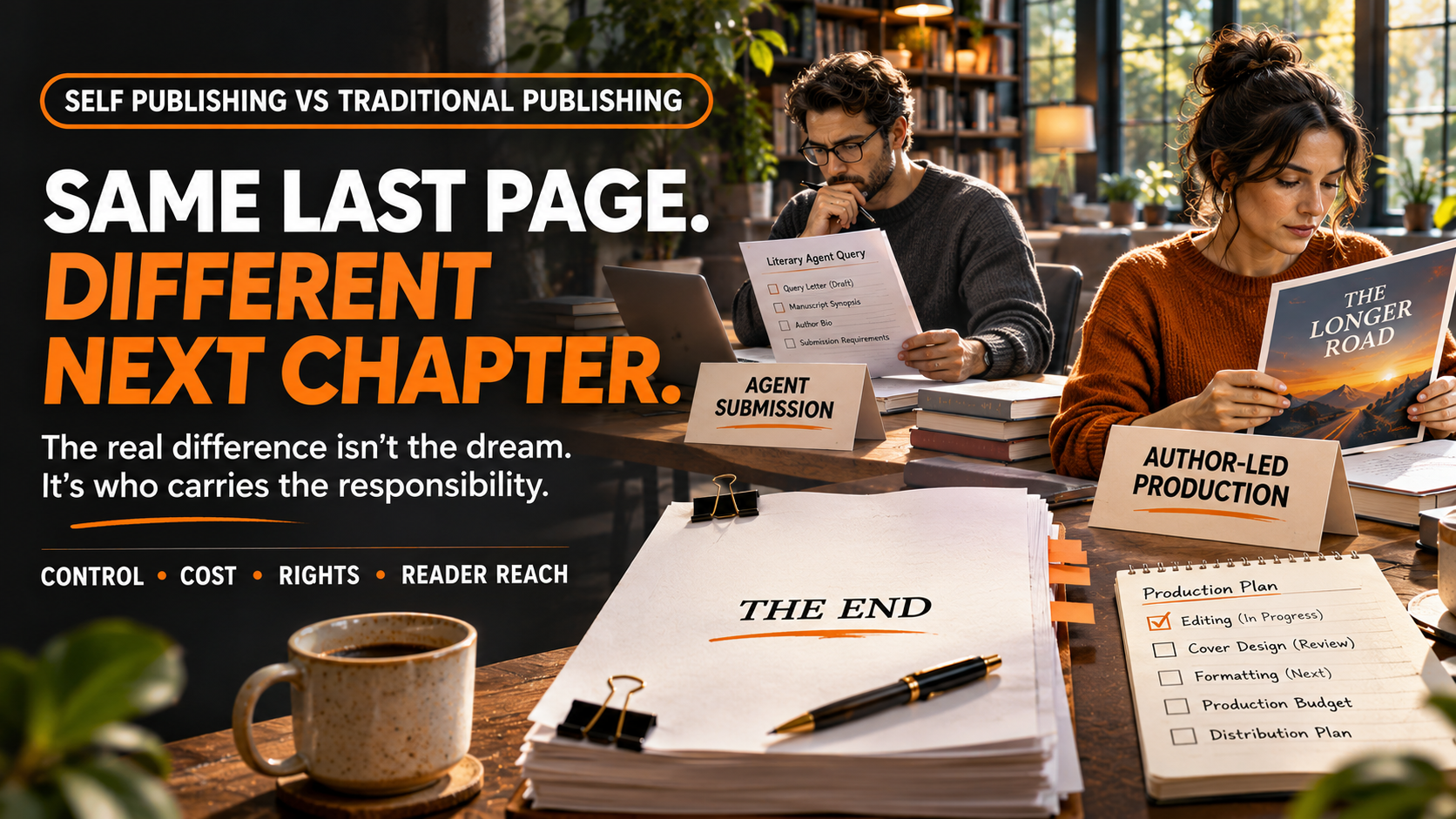
Two authors finish their manuscripts on the same day.
One starts querying literary agents, hoping to work with a publishing house that can bring the book into stores. The other hires an editor, commissions a cover, and begins preparing the book for independent publication.
Neither author has necessarily made the better decision.
The first may spend considerable time pursuing a deal that never materializes. The second may publish sooner but underestimate the work required to find readers.
Both want a successful book. They are choosing different responsibilities, financial risks, and kinds of support.
That is what the Self Publishing vs Traditional Publishing decision is really about.
At Amazon KDP Experts, we believe a publishing plan should begin with the author's goals, the manuscript's needs, and the realities of reaching its intended audience. Professional support can help with an independent release, but self-publishing is not automatically the right choice for every author.
This guide compares the routes without declaring a universal winner. You'll learn who pays for production, what happens to your publishing rights, how royalties actually work, and which questions to answer before approaching an agent or preparing your own book files.
Key Takeaways
- Traditional publishing generally funds production. A publisher selects the work, acquires specified publishing rights, and manages production and distribution under a contract.
- Self-publishing gives authors more decision-making control. You manage the work yourself or hire professionals, but you also carry the financial and commercial risk.
- Higher royalty percentages don't guarantee higher profits. Production costs, printing charges, advances, marketing expenses, and sales volume all matter.
- The choice isn't limited to two paths. Small presses, reputable hybrid publishers, and assisted self-publishing providers offer different arrangements.
- Start with what your book needs. Your readership, rights, timetable, budget, and preferred level of involvement should shape the decision.
Self Publishing vs Traditional Publishing: What's the Actual Difference?
Traditional publishing means a publisher acquires agreed rights to publish your book and takes responsibility for the costs and activities specified in the publishing agreement. The author is paid under that contract, sometimes including an advance against royalties.
Self-publishing means the author acts as the publisher, retaining control of publication decisions and arranging the writing, editing, design, production, distribution, and promotion independently or through hired specialists.
The central distinction isn't whether professionals work on your book.
Both approaches can involve professional editors, cover designers, formatters, and marketers.
The difference is who makes the publishing decisions, who funds the work, who controls the licensed rights, and who assumes the business risk.
Self-Publishing vs Traditional Publishing at a Glance
| Decision Factor | Traditional Publishing | Self-Publishing |
|---|---|---|
| Manuscript selection | Publisher decides what to acquire | Author decides what to publish, subject to platform policies |
| Production expenses | Generally paid by the publisher | Paid or handled by the author |
| Advance payment | Possible; common with larger trade publishers but not universal | No publisher-funded advance |
| Royalties | Determined by the publishing contract | Determined by retailer/distributor terms and costs |
| Creative decisions | Shared or controlled by the publisher under contract | Primarily controlled by the author |
| Publishing rights | Specific rights licensed or transferred under an agreement | Generally retained by the author, subject to other contracts |
| Publication timeline | Depends on acquisition, production, and release scheduling | Depends on manuscript readiness and production |
| Bookstore distribution | Established trade distribution may be available | Possible through distributors, but stocking is harder to secure |
| Marketing | Publisher and author may both participate | Author plans, funds, and manages promotion |
| Financial risk | Publisher generally carries production risk | Author carries production and promotional risk |
These are typical trade-book arrangements, not guarantees. Small presses, specialty publishers, distribution programs, and individual contracts may differ significantly.
How Traditional Publishing Works
Traditional publishing begins with selection.
A publishing house decides which books fit its list, readership, editorial direction, and commercial expectations.
For many major U.S. trade publishers, authors approach the market through a literary agent.
A typical process looks like this:
- Prepare the submission. Fiction authors usually need a completed manuscript, while some nonfiction projects may be pitched through a proposal and sample material.
- Query literary agents. The author sends targeted queries according to agents' submission requirements.
- Pursue representation. An interested agent may request revisions before submitting the project to publishers.
- Negotiate a publishing agreement. If a publisher makes an offer, the contract establishes payment, rights, deadlines, and other obligations.
- Complete editorial and production work. The publisher manages its agreed responsibilities for editing, design, production, and distribution.
- Release and promote the book. The publisher coordinates its publication schedule while the author may participate in marketing and publicity.
Not every traditionally published book follows this exact process. Some independent presses accept direct submissions, and the services offered can vary.
What Does a Traditional Publisher Actually Provide?
A suitable publishing partner may bring editorial expertise, established sales relationships, production resources, publicity contacts, and the ability to place books before buyers that individual authors may struggle to reach.
Those relationships can be especially valuable when a book's goals depend on physical bookstore exposure, library sales, recognized review channels, or an established publishing imprint.
However, acquiring a publisher does not automatically mean your book will receive a substantial national marketing campaign.
Nor does a traditional publishing offer guarantee strong sales.
The Main Trade-Off
You gain access to a publisher's resources and professional decision-making.
In exchange, you accept an acquisition process, contractual limits, and less independent control over some aspects of the book.
That can be a productive partnership for authors who value editorial collaboration and trade distribution.
It can be frustrating for authors whose book depends on a specific creative vision or release timetable.
How Self-Publishing Works
With self-publishing, there is no traditional acquisitions committee deciding whether your manuscript fits a publishing list.
You are responsible for determining whether the book is ready, suitable for its intended readers, and properly prepared for distribution.
That doesn't mean you must personally perform every task.
You can work independently, hire individual specialists, or coordinate the process through an assisted publishing provider.
What You Need to Manage
A professional independent publishing process commonly includes:
- Manuscript development and editorial review.
- Cover design appropriate to the book's genre and formats.
- Ebook and print interior preparation.
- Rights, licensing, and ISBN decisions where applicable.
- Book metadata, categories, keywords, and pricing.
- Retailer or distribution account setup.
- Proofing and final file approval.
- Marketing and ongoing book management.
Platforms such as Amazon Kindle Direct Publishing allow eligible authors to upload and distribute books without securing a traditional publishing deal.
But a book being available for purchase isn't the same as that book being professionally prepared or effectively marketed.
The Real Advantage of Self-Publishing
The author can make decisions based on the needs of the project rather than waiting for a publisher to acquire it.
That may include choosing a niche subject, selecting a cover direction, coordinating a series schedule, changing prices, updating files, or planning promotions.
Control, however, creates responsibility.
An author who independently commissions a poorly edited manuscript or misleading cover has no publishing house to absorb the consequences.
If your manuscript and design files are ready but platform preparation remains confusing, professional KDP publishing support can help organize formats, metadata, previews, and author-approved submission decisions.
The key is using professional assistance without unnecessarily giving up control of your publishing account or rights.
Who Pays, Who Earns, and Who Takes the Risk?
A frequent argument in this comparison is that self-publishing offers higher royalties.
That can be true on a per-copy basis.
But the comparison is incomplete until you consider advances, production expenses, selling prices, platform charges, and the number of copies sold.
Traditional Publishing: Advances and Contractual Royalties
A traditional publishing agreement may include an advance against royalties.
An advance is generally money paid ahead of the royalties the book is expected to earn.
As qualifying royalties accumulate, they are applied against that advance. Additional royalty payments generally begin after the advance earns out, subject to the contract's accounting provisions.
An advance does not usually have to be repaid simply because the book sells fewer copies than expected, provided the author fulfills the contractual obligations. The actual agreement controls the exceptions.
Not every small press offers an advance.
Royalty calculations also differ by format and contract. One rate may be based on a list price, while another may use the publisher's net receipts.
You cannot accurately compare a publisher's royalty percentage with a KDP percentage until you know what each percentage is applied to.
Self-Publishing: Royalties After Distribution Costs
For eligible Kindle ebooks, Amazon KDP offers 35% and 70% royalty options.
As of the July 2026 change, the 70% option on Amazon.com can apply to eligible ebooks priced between $2.99 and $12.99, subject to the applicable requirements.
The 70% calculation also involves delivery costs and other eligibility conditions. Not every sale earns 70%.
For printed books, KDP uses royalty rates determined by marketplace, price, and distribution method, with printing costs deducted.
Amazon explains the ebook calculation in its official KDP royalty documentation.
A Practical Royalty Example
Consider a hypothetical paperback sold through Amazon.com.
| Item | Illustrative Amount |
|---|---|
| Paperback list price | $14.99 |
| Applicable standard-distribution royalty rate | 60% |
| Estimated printing charge used for this example | $5.00 |
| Approximate author royalty per copy | $3.99 |
The calculation is:
($14.99 × 60%) − $5.00 = approximately $3.99
This is an illustrative calculation, not a quote for your book or a comparison against a specific traditional publishing contract.
Your actual printing cost depends on the book's specifications and marketplace.
Even if that royalty is higher than what a traditional contract offers per copy, the author may have already paid for editing, design, formatting, and advertising.
Those expenses need to be recovered before the project becomes profitable.
The Better Financial Question
Instead of asking:
Which publishing route pays the highest royalty percentage?
Ask:
Which route offers a realistic path to recovering my investment and reaching my readers?
For a publisher-funded book, consider the advance, royalty terms, rights granted, distribution, and expected support.
For an independently published book, consider the cost of production, actual royalty per edition, promotional spending, and the sales required to recover those expenses.
Our guide to how much it costs to self-publish a book explains the individual production expenses that authors should budget for before choosing professional services.
The important distinction: A royalty is not the same as profit, and an advance is not a guarantee of commercial success.
Who Owns Your Book Under Each Publishing Model?
This is one of the most consequential decisions because the effects can continue long after the book is released.
The familiar claim that a traditional publisher automatically owns an author's copyright is too simplistic.
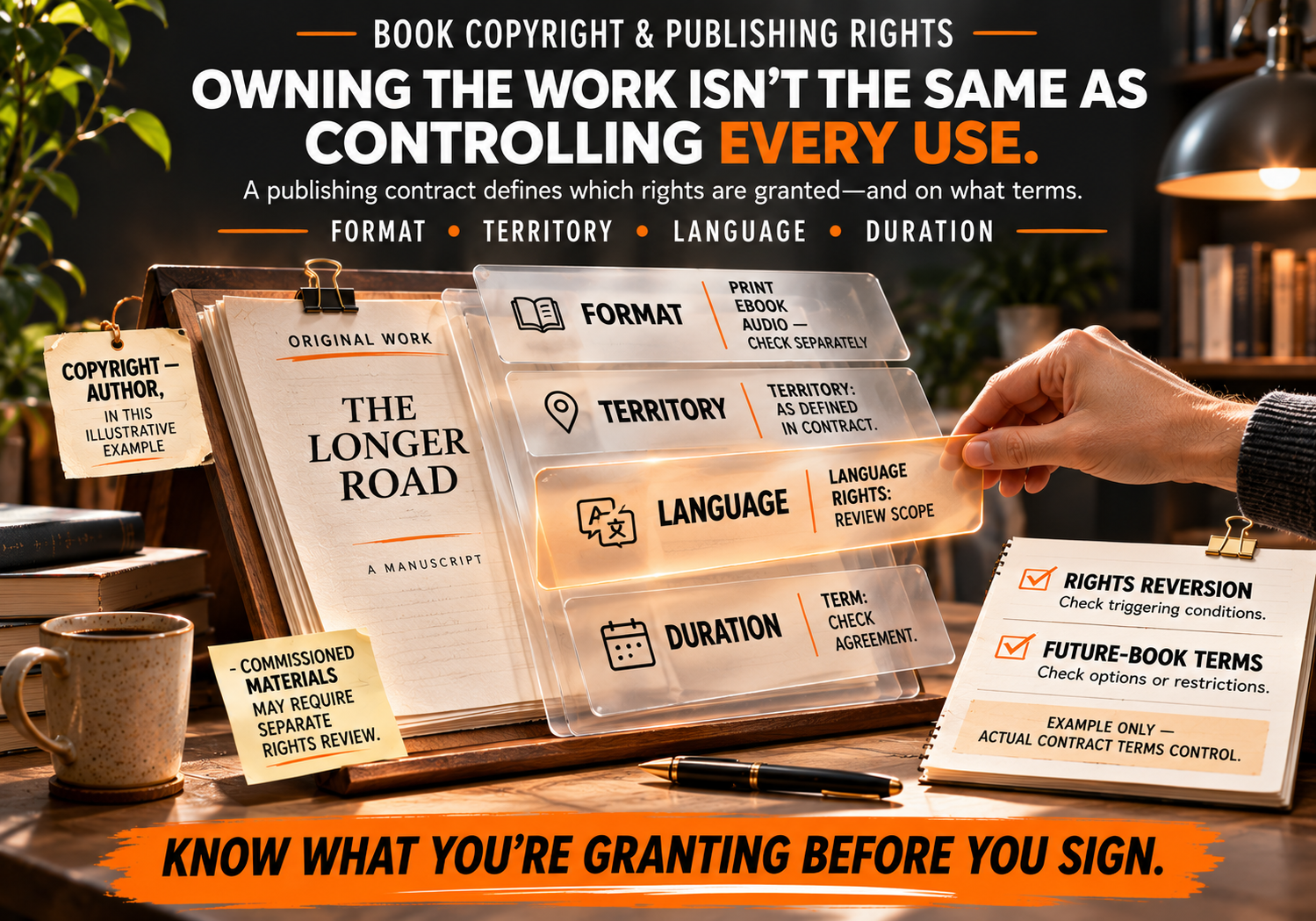
In many conventional trade-publishing agreements, the author retains copyright while granting the publisher exclusive rights to publish the work in specified forms, languages, territories, or markets.
The precise contract determines what the publisher can do.
What to Examine in a Traditional Publishing Contract
Rights Granted
Does the publisher receive English-language print and ebook rights, or are audiobook, translation, adaptation, and other subsidiary rights included?
Only grant rights you understand and that the publisher has a credible plan to exploit.
Territory and Duration
Does the agreement cover North America, worldwide English-language rights, or additional territories?
How long can the publisher retain those rights?
Rights Reversion
If the book stops selling meaningfully or the publisher no longer exploits certain rights, what mechanism allows the author to reclaim them?
A weak reversion clause can make future publishing decisions much harder.
Future-Book Obligations
Does the contract include an option, right of first negotiation, or restriction affecting your next book?
Consider your wider writing career, not only the manuscript being acquired.
A qualified literary agent or publishing attorney can help you evaluate these provisions.
Does Self-Publishing Mean You Automatically Own Everything?
Not necessarily.
You may own the copyright in your original manuscript, but that doesn't automatically mean you own every commissioned illustration, photograph, typeface license, cover component, or other creative asset used in the book.
Review your agreements with ghostwriters, illustrators, cover designers, photographers, and other contributors.
Confirm what you can reproduce, modify, distribute, and reuse.
Also check any exclusivity arrangements you choose with retailers or distributors.
Self-publishing gives you more opportunities to control your rights, but that control depends on the agreements you actually sign.
Which Publishing Route Offers Better Bookstore and Library Distribution?
Traditional publishers generally have a stronger established route into physical bookstores and institutional sales channels.
Their teams may work with wholesalers, retail buyers, distributors, and other trade partners.
But a publishing contract does not guarantee that every bookstore will stock your book.
Three Different Meanings of Distribution
1. Listed for sale: Customers can find the book through an online retailer.
2. Available to order: A bookstore or library supplier can potentially obtain the title through an eligible distribution channel.
3. Physically stocked: A store or library has chosen to purchase and carry copies.
These are different outcomes.
Self-published books can be available to order through suitable distributors without being stocked on shelves.
Bookstores make their own purchasing decisions and may consider demand, trade discounts, returnability, distribution arrangements, genre fit, and local interest.
Which Route Makes More Sense?
If your publishing goal depends heavily on broad physical bookstore distribution, a strong traditional publisher may offer meaningful advantages.
If you primarily expect to reach readers through online retail, direct audience relationships, events, or a specialized professional community, the distribution advantage may matter less.
Neither model makes the marketing problem disappear.
Who Has More Creative Control?
Self-publishing generally gives you more direct authority over the book's final presentation.
You can approve the manuscript, title, cover, formats, price, release date, and promotional direction.
You can also make changes without seeking permission from a traditional publishing house, although retailers and distribution platforms have their own processes and restrictions.
Traditional publishing involves collaboration with a publisher whose contract may give it substantial decision-making authority.
That can be valuable when an experienced editorial or design team brings market knowledge you don't have.
It can also create disagreement over covers, titles, positioning, or release schedules.
A Question Worth Asking Yourself
Suppose a publisher believes your novel needs a different title and cover to reach the intended audience.
Would you welcome the collaboration, even if the final decision differed from your original vision?
Or would you prefer to select the people advising you and retain the final approval?
Your answer reveals more about your publishing fit than a simple desire for creative freedom.
Is Traditional Publishing Slower Than Self-Publishing?
Usually, the key difference is the acquisition process.
A traditionally published book may pass through agent querying, publisher submission, negotiation, contract preparation, editorial development, production scheduling, and distribution planning.
There is also the possibility that no publisher acquires the manuscript.
With self-publishing, you can begin production without waiting for that acquisition decision.
But that doesn't mean a professionally prepared book can or should be rushed.
A substantial memoir may need lengthy revisions. An illustrated children's book may depend on original artwork. A complex nonfiction book may require permissions, indexing, charts, or technical review.
Compare Timelines by Work Remaining
| Stage | Traditional Publishing | Self-Publishing |
|---|---|---|
| Acquisitions decision | Agent/publisher approval may be required | No traditional acquisition process |
| Manuscript revision | Agent and publisher may request revisions | Author and hired editor set the revision scope |
| Design and production | Publisher's production schedule | Author-managed production schedule |
| Release-date control | Usually determined with the publisher | Largely author-controlled within platform rules |
| Unexpected delays | Acquisition, contracts, production, distribution | Writing, editing, suppliers, files, platform review |
The right question isn't which route can publish fastest under ideal conditions. It's which route can deliver a book that meets your standards within an acceptable timetable.
Does a Traditional Publisher Do All the Book Marketing?
Not necessarily.
A traditional publisher may provide sales representation, publicity, trade marketing, distribution support, and other promotional resources.
The amount and duration of that support depend on the publisher, title, contract, and marketing plan.
Authors may still be expected to participate in interviews, events, online promotion, or reader outreach.
Self-published authors must organize their marketing directly or hire help.
That work can include genre positioning, product-page preparation, email marketing, advertising, advance-reader outreach, launch communications, and ongoing promotion.
If you're deciding how to reach readers independently, book marketing support can help you evaluate relevant channels and campaign requirements without assuming that every book needs the same advertising plan.
The Audience You Already Have Matters
Imagine two nonfiction authors.
One has an established audience of professionals who already attend the author's workshops and subscribe to the author's newsletter.
The other is writing a book for a broad audience the author does not currently reach.
The first may be well positioned to sell directly to an existing community through independent publication.
The second may benefit from a publisher with stronger trade relationships and broader discovery opportunities.
Neither outcome is automatic.
But the reader-acquisition problem is different for each book.
What About Hybrid Publishers and Assisted Self-Publishing?
The modern publishing landscape is broader than two categories.
Understanding the distinctions matters because some organizations use similar language for fundamentally different arrangements.
Traditional Independent and Small Presses
A small press can still be a traditional publisher.
The publisher selects the books, funds the agreed production work, and pays the author according to a publishing contract.
Some small presses focus on particular genres, regional audiences, literary communities, or specialist subjects.
Their distribution and marketing capabilities vary considerably.
Genuine Hybrid Publishers
A hybrid publishing model generally involves an author financial contribution alongside publishing responsibilities undertaken by the company.
A reputable hybrid publisher should do more than bundle editing, printing, and design into a package.
The company should have a meaningful publishing program, selection standards, professional production, distribution capabilities, clear contracts, and a credible sales approach.
The Authors Guild discusses the legal and commercial distinctions in its guidance on hybrid publishing contracts.
Assisted Self-Publishing Providers
With assisted self-publishing, an author pays a company or individual professionals for specific services while remaining the publisher of the book.
Depending on the agreement, that assistance might include ghostwriting, editing, illustration, cover design, formatting, metadata, KDP preparation, or marketing.
The service provider should explain the deliverables and who controls the publishing account, files, and rights.
A fee-for-service relationship does not automatically make that company a hybrid publisher.
An Essential Warning
If a company presents itself as a conventional traditional publisher but requires the author to purchase an expensive publishing package, examine that arrangement carefully.
A company charging for legitimate professional services is not automatically dishonest.
The concern is misrepresenting what the author is paying for, which rights are being granted, and what outcomes the company can actually deliver.
For a closer look at evaluating providers, our guide to choosing a book publishing company without losing your rights or money explains how to assess contracts, deliverables, and warning signs.
The Book-First Decision Ledger: Which Route Fits Your Goals?
Many comparison guides end by telling you to choose the route that feels right.
That advice is incomplete if you haven't identified the decisions you cannot compromise on.
Use the following ledger before committing to either path.
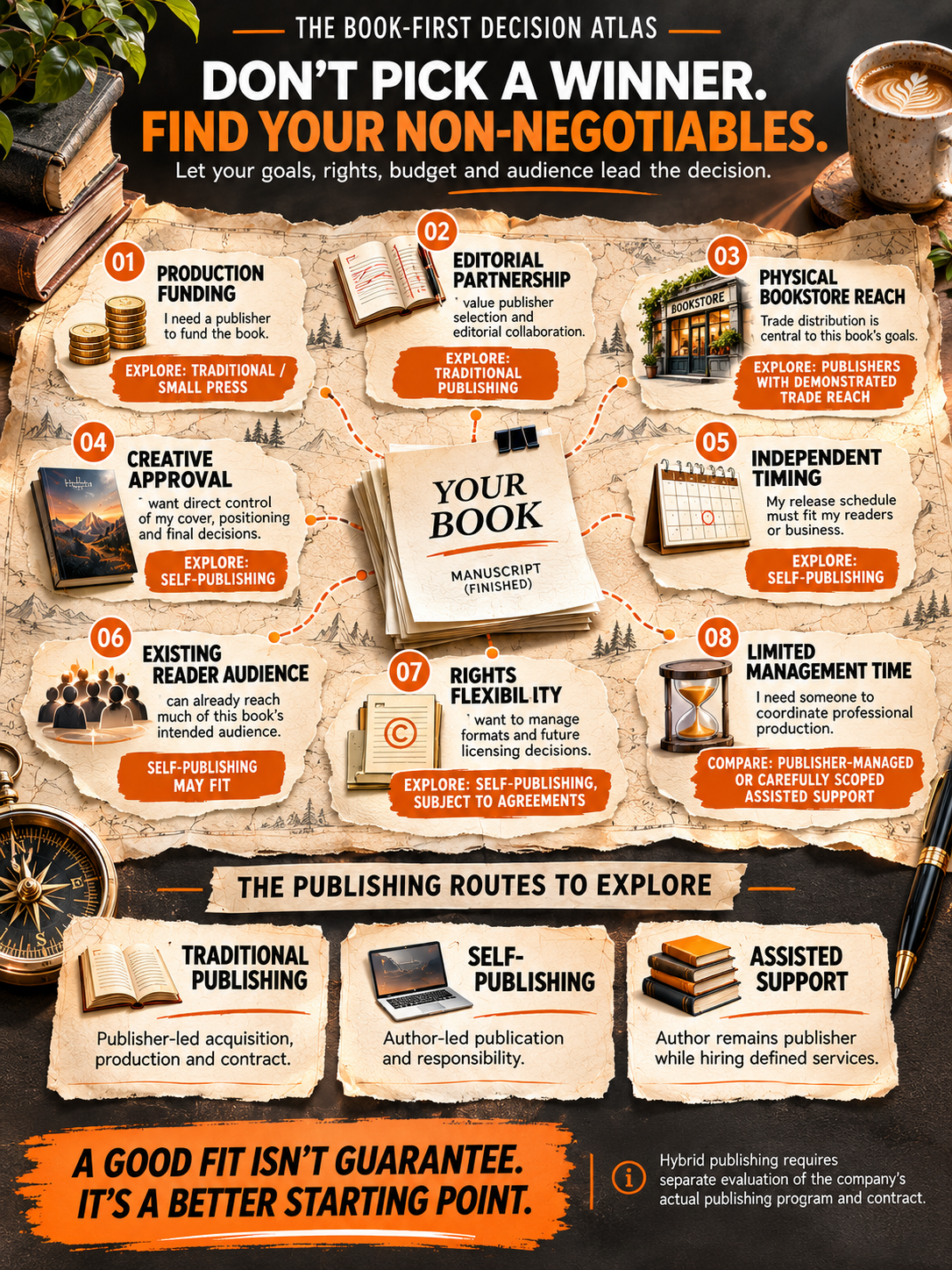
| Your Non-Negotiable | If This Describes You | Route Worth Investigating First |
|---|---|---|
| Publisher-funded production | You cannot or do not want to finance production yourself | Traditional publisher or suitable independent press |
| Final creative approval | You want direct authority over design, positioning, and release decisions | Self-publishing |
| Broad trade distribution | Physical bookstore and institutional reach are central goals | Traditional publishing with demonstrated distribution |
| Predictable independent schedule | Your release must coordinate with your business or reader community | Self-publishing |
| Publisher editorial partnership | You value acquisition-based selection and collaboration with a publishing team | Traditional publishing |
| Existing reader access | You can already reach much of the intended audience | Self-publishing may offer stronger direct control |
| Rights flexibility | You want to manage formats, licensing, and future editions independently | Self-publishing, subject to your agreements |
| Limited production-management time | You need help coordinating professional work | Traditional publishing or carefully scoped assisted publishing |
Treat these as directional indicators, not a scoring system that guarantees the right answer.
Test the Decision Against Three Questions
1. What is the book supposed to accomplish?
Is your main objective a widely distributed commercial novel, a professional credibility asset, a family memoir, a specialist reference book, or a long-running fiction series?
2. What responsibility are you willing to accept?
Would you rather pursue publisher acquisition and work within its agreements, or finance and oversee the publishing process yourself?
3. What outcome would make you regret your choice?
Would it be years spent waiting for a deal? Paying for production without recouping the cost? Losing control of the cover? Or missing the bookstore exposure that mattered most to you?
The answers help reveal which trade-offs you can live with.
Four Realistic Author Scenarios
These examples are illustrative publishing situations, not Amazon KDP Experts client case studies or promised outcomes.
Scenario 1: The Romance Author Planning a Series
An author has completed the first novel in a connected romance series and has detailed plans for future books.
The author wants to coordinate covers, release dates, pricing, and reader communication across the series.
Why self-publishing may fit: The author can manage the release schedule and maintain consistent creative direction.
What could make it difficult: The author must fund professional preparation and develop a sustainable reader-acquisition plan.
Decision: Independent publication may align with the author's priorities if the production budget and marketing responsibilities are realistic.
Scenario 2: The Debut Literary Novelist Seeking Bookstore Reach
An author has written a literary novel and wants to pursue an established publisher's editorial program, review opportunities, and physical trade distribution.
The author is comfortable revising the manuscript and waiting through a selective acquisitions process.
Why traditional publishing may fit: A strong publisher could offer the collaboration and distribution relationships the author values.
What could make it difficult: An agent or publishing deal may never materialize, and the author may have limited control over some production decisions.
Decision: Querying appropriate agents and independent presses may be sensible before committing to independent publication.
Scenario 3: The Consultant Writing a Specialized Business Book
A consultant has years of professional experience, workshop content, and access to a specific client audience.
The book will explain a practical framework that supports the consultant's wider professional work.
Why self-publishing may fit: The author already knows the target readership and wants control over the book's positioning, availability, and use alongside other professional activities.
What could make it difficult: The manuscript still needs strong writing, credible examples, editing, and production quality.
Decision: An assisted independent publishing model may be suitable if it allows the author to commission the necessary work while controlling the publication.
Scenario 4: The Children's Book Author With a Specific Creative Vision
An author has developed an illustrated story and wants a particular visual approach, educational message, and series identity.
The book may be sold through school visits, local events, and online retail.
Why self-publishing may fit: The author can select an illustrator and retain control over the visual presentation, subject to the creative contracts.
Why a traditional publisher might fit instead: A suitable children's publisher could provide experienced picture-book development and access to school, library, and bookstore channels.
Decision: Compare the actual offer and distribution plan, not simply the reputation of the publishing model.
Can You Move From Self-Publishing to Traditional Publishing Later?
Yes, an author's career can include both models.
But changing routes isn't always simple, especially for a book that has already been published.
Trying Traditional Publishing First
An author may decide to query agents or suitable presses before pursuing an independent release.
If that is the plan, establish a realistic submission strategy and a point at which you'll reassess the project.
Don't assume that an agent will offer representation or that a publisher will make an offer.
Also avoid making a manuscript publicly available as a self-published edition while you're simultaneously representing it as unpublished without checking submission rules and notifying relevant parties.
Moving From Self-Publishing to a Traditional Deal
Some authors secure traditional publishing deals after independently publishing.
A successful indie release can provide evidence of readership, but it does not guarantee that a traditional publisher will acquire the same book.
Publishers may be more interested in a new project, a different format, or rights that remain available.
A Real Author Example: Nathan Bransford
Author and former literary agent Nathan Bransford has experience with both publishing models.
His Jacob Wonderbar series was traditionally published, while his writing guides How to Write a Novel and How to Publish a Book were independently published.
He has also described regaining rights to earlier traditionally published work and republishing it himself.
His experience demonstrates that a publishing career can evolve across different models. It does not mean every author can automatically recover rights or obtain a new deal after self-publishing.
Before Changing Routes, Check Your Rights
If a publisher currently holds exclusive rights to an edition, format, territory, or language, you may not be free to republish that same material independently.
Review the agreement, rights-reversion provisions, and any relevant termination or licensing restrictions before taking action.
Seven Mistakes to Avoid Before Choosing a Publishing Route
1. Comparing Royalty Percentages Instead of Author Earnings
A higher royalty rate doesn't automatically produce more profit.
Compare contract terms, production costs, distribution charges, and realistic sales assumptions.
2. Assuming Traditional Publishers Guarantee Sales
A publisher may provide valuable professional resources and market access, but consumer demand remains uncertain.
3. Believing Self-Publishing Means Working Alone
Independent publishing allows authors to commission professional work. The challenge is selecting, managing, and paying for the right support.
4. Assuming a Distributor Guarantees Bookstore Shelves
Being available for order is different from a bookstore purchasing inventory.
5. Signing Away Rights You Don't Understand
Pay attention to formats, territories, duration, subsidiary rights, future-book obligations, and reversion clauses.
6. Choosing a Publishing Company Based on Guarantees
Be cautious of providers promising bestseller status, guaranteed sales, automatic bookstore placement, or outcomes they cannot control.
Ask for precise written responsibilities and deliverables.
7. Choosing a Route Before Understanding Your Readers
A book designed for a small professional community may need a different distribution and marketing strategy from a commercial thriller or an illustrated children's series.
Start with the intended audience and work backward toward the publishing model.
How to Make Your Final Publishing Decision
You don't need to predict every future sale.
You need a practical next step based on the information you can reasonably establish now.
Step 1: Define the Book's Primary Goal
Write one sentence describing what a successful publication would accomplish for you.
Be specific about readership, distribution, income, professional objectives, or personal significance.
Step 2: Evaluate the Manuscript's Readiness
Determine whether the book needs substantial writing, developmental editing, copyediting, illustration, design, research, or permissions before publication.
A publishing model won't fix a manuscript that isn't ready.
Step 3: Compare the Actual Costs and Offers
For traditional publishing, evaluate genuine representation or acquisition opportunities and the terms being offered.
For self-publishing, request clear production estimates and identify the work you can competently handle yourself.
For hybrid or assisted options, examine the complete contract and service scope.
Step 4: Confirm Rights and Account Control
Understand which rights you are granting, what files you will receive, how revenue is paid, who controls retailer accounts, and what happens if the relationship ends.
Step 5: Choose a Decision Point
If you're pursuing agents, decide when you will review your progress.
If you're preparing an independent publication, establish realistic production milestones and approval checks.
Avoid leaving the book in an indefinite state of indecision.
Your publication plan can change as new information emerges. The important thing is to make changes deliberately.
Final Thoughts: Choose the Model That Serves Your Book
The debate over Self Publishing vs Traditional Publishing becomes more useful when you stop treating it as a competition.
Traditional publishing may offer a valuable editorial partnership, publisher-funded production, and trade distribution, but requires selection and agreement on how the publisher will exploit your work.
Self-publishing may give you more creative authority, publishing flexibility, and direct control of your business, but requires you to finance or perform the work that a publishing house would otherwise manage.
A small press might be the right fit for a specialized book. An assisted publishing provider might be appropriate for an author who wants independence but needs professional production support.
The best answer is not the one with the most attractive royalty percentage or the shortest promised timeline.
It's the route whose responsibilities, rights, costs, and opportunities align with the book you're actually trying to publish.
Choose your audience first. Understand the trade-offs. Then choose the publishing path.