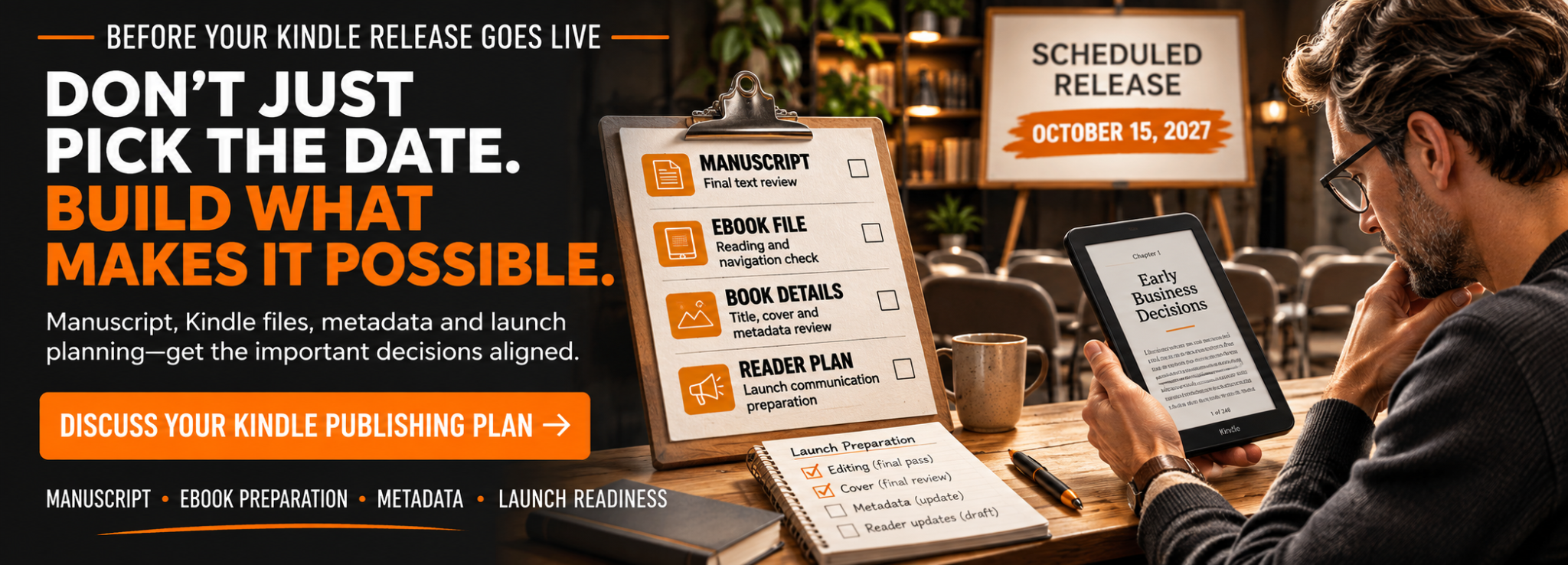
You have a book idea, a release date in mind, and readers asking when they can order it.
The manuscript isn't finished yet. Your cover may still need work. But you want to give people somewhere to find the book before launch day.
Until recently, Amazon KDP limited Kindle ebook pre-orders to a year in advance.
That changed in September 2026.
Authors creating eligible new pre-orders can now schedule their Kindle ebook release up to 18 months ahead. Amazon also changed how often release dates can be postponed and what happens when authors miss their submission deadlines.
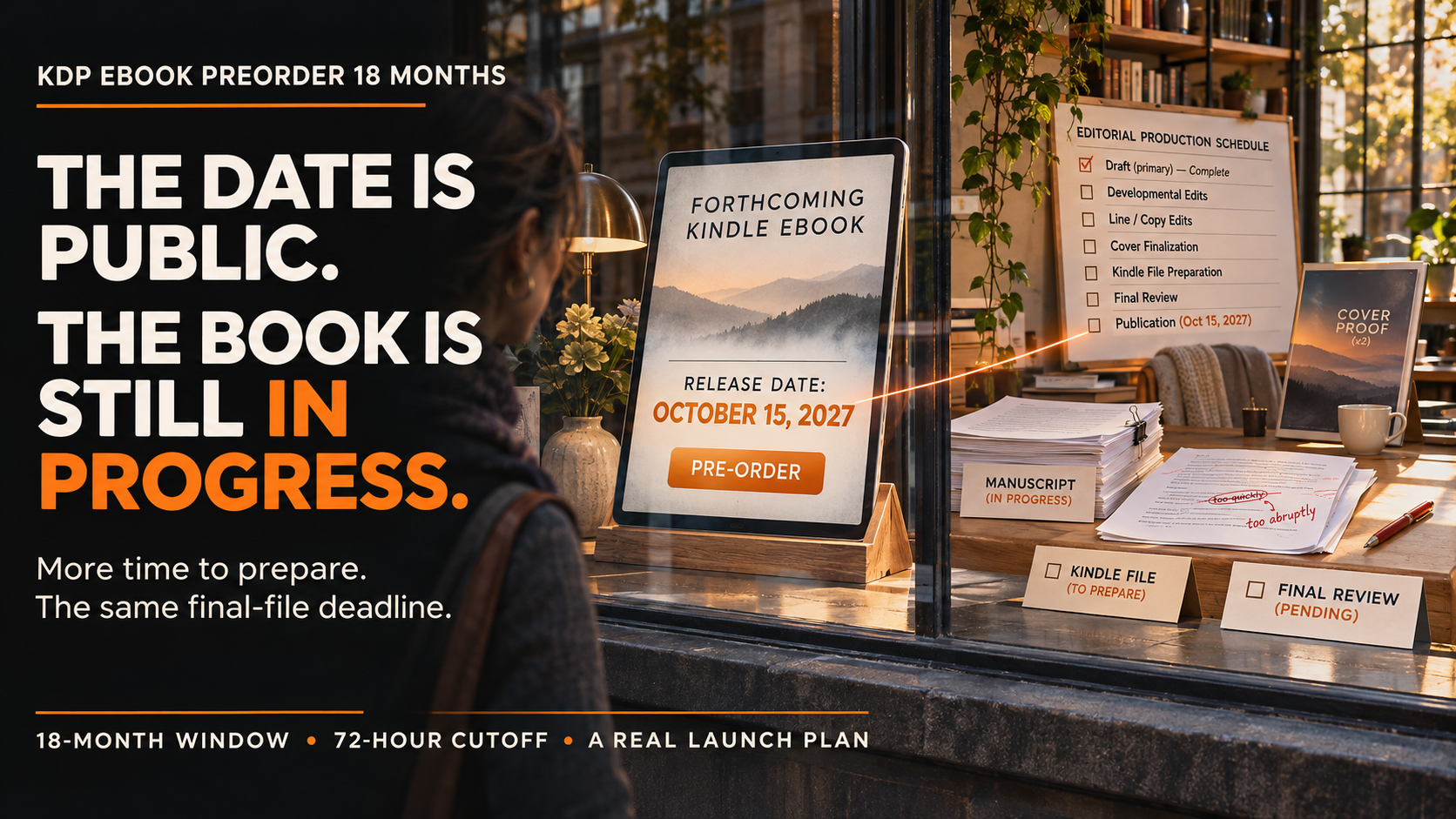
The extra time sounds useful. But opening a pre-order too early can create problems if your manuscript, publishing schedule, or promotional plans aren't ready to support a public release commitment.
At Amazon KDP Experts, a publishing date should be connected to the actual condition of the book, not just the date an author hopes to finish it.
Here's what changed, how the new rules work, and how to decide whether a longer Kindle pre-order is right for your book.
Key Takeaways
- New Kindle ebook pre-orders can run for 18 months. The expanded window applies to pre-orders created on or after September 2, 2026.
- The manuscript deadline remains strict. You must upload and submit the final ebook file at least 72 hours before release.
- Postponements are more flexible, not unlimited. Eligible newer pre-orders can be delayed twice, within six months of the original release date.
- Pre-order visibility is not automatic demand. A longer launch window helps when you have a credible production schedule and a reason for readers to reserve the book.
What Changed With Amazon KDP Ebook Pre-Orders in 2026?
Amazon KDP expanded its Kindle ebook pre-order window from 12 to 18 months for pre-orders created on or after September 2, 2026. The update also allows more postponement flexibility and revises penalties for cancellations or missed manuscript deadlines. Earlier pre-orders retain their original scheduling limits.
The critical detail is when the pre-order was created, not when the ebook will be released.
A pre-order created in August 2026 doesn't automatically gain the newer 18-month allowance simply because its release date is in 2027.
Old vs. New KDP Pre-Order Rules
| Rule | Created Before September 2, 2026 | Created On or After September 2, 2026 |
|---|---|---|
| Maximum advance release window | 12 months | 18 months |
| Allowed postponements | Once | Up to twice |
| Postponement limit | Up to 30 days beyond the current release date | No later than six months after the original release date |
| Final manuscript deadline | At least 72 hours before release | At least 72 hours before release |
| Active pre-orders per account | Up to 10 titles | Up to 10 titles |
| Eligible format | Kindle ebooks | Kindle ebooks |
Amazon's current Kindle ebook pre-order guidelines establish the new window and eligibility rules.
A separate change also affects cancellations: KDP now provides a one-time account-level courtesy for the first cancellation or missed deadline, with a six-month loss of pre-order privileges after a second such event. Older suspensions already imposed before September 2, 2026 retain their previous terms.
Pro Tip: If you're updating an article, launch plan, or publishing checklist written before September 2026, review its pre-order rules. Guidance that still states a universal 12-month limit or automatic one-year suspension can now be misleading.
Who Can Use the New 18-Month KDP Pre-Order Window?
The extended window is available for eligible new Kindle ebook titles created on or after the policy change.
Amazon states:
"Pre-orders are available for new eBook titles only."
The main eligibility conditions are straightforward:
- The title must be a new Kindle ebook publication eligible for pre-order.
- Public-domain ebooks are not eligible.
- You can have up to 10 active pre-order titles at one time.
- The ebook must meet KDP's content and publishing requirements.
- The final file must be submitted before the designated deadline.
Once an existing pre-order title is released, that active slot becomes available for another eligible pre-order.
Does the 18-Month Rule Apply to Paperbacks and Hardcovers?
No.
KDP offers a separate scheduled-release option for eligible print books, but it does not provide the same customer pre-order feature for paperbacks or hardcovers.
A scheduled print release can be set up to 90 days ahead, with the product detail page generally remaining hidden until the release date.
That is different from a Kindle ebook pre-order, where the detail page becomes available after review and customers can reserve the ebook in advance.
| Feature | Kindle Ebook Pre-Order | KDP Print Scheduled Release |
|---|---|---|
| Supported edition | Kindle ebook | Eligible paperback or hardcover |
| Advance window | Up to 18 months for qualifying newer pre-orders | Up to 90 days |
| Product page before release | Available after approval | Generally hidden |
| Customer orders before release | Yes | No, not through KDP's scheduled-release feature |
| Main purpose | Accept advance ebook orders | Coordinate print availability on a future date |
If you're planning a simultaneous ebook and paperback launch, treat each edition as a separate production and platform setup task.
Don't assume choosing the same release date creates identical ordering options.
How Do You Set Up an 18-Month Ebook Pre-Order on KDP?
You can create a Kindle pre-order through your KDP Bookshelf without having the final manuscript ready on the first day.
However, you still need a credible book concept, accurate listing information, a release date, and a plan for delivering the promised edition.
Step 1: Open Your KDP Bookshelf
Sign in to your KDP account.
Select + Create, then choose Create eBook.
Start entering your Kindle ebook details, including the title, author information, description, publishing rights, and other required fields.
Step 2: Select the Pre-Order Option
On the Kindle eBook Details page, locate the Pre-order section.
Choose Make my Kindle eBook available for Pre-order.
Then select the intended release date.
For qualifying new pre-orders, KDP allows dates up to 18 months in the future.
Step 3: Check the Submission Timer
After you choose the release date, KDP displays a countdown showing when your final manuscript is due.
Make that deadline part of your actual publishing calendar.
Don't record only the public release date.
The submission deadline is the more important operational date for your writing, editing, formatting, and final review process.
Step 4: Complete the Required Setup
Continue through the ebook content and pricing sections.
Prepare an appropriate cover, accurate book metadata, publishing-rights information, territories, and pricing.
Your final manuscript does not necessarily need to be uploaded when you first make the pre-order listing available, but it must be supplied before KDP's submission deadline.
If you submit a manuscript early, eligible readers may be able to preview a sample. The sample should represent the book you're preparing to release.
Step 5: Submit the Pre-Order
Complete the required setup and submit the title for KDP review.
Do not confuse saving an unfinished draft with successfully submitting a live pre-order.
Once approved, the Kindle product page can display a Pre-order button, allowing readers to reserve the book.
Step 6: Upload and Submit the Final Manuscript
Before the deadline, return to the title in your Bookshelf.
Open its Kindle ebook content settings, upload the approved final manuscript, continue through the remaining setup pages, and select Submit for pre-order.
KDP must receive the final version you intend to deliver to customers.
Submitting the file starts review activity, so leave time to address any unexpected problems.
Pro Tip: Use a Publishing-Ready File Checklist
Before submitting the final ebook, confirm the approved manuscript, chapter navigation, internal links, title page, copyright details, images, and cover information.
If your project needs assistance with metadata, Kindle file preparation, previews, or author-approved submission checks, KDP book publishing services can help address the specific work still outstanding.
What Happens if You Miss the 72-Hour KDP Pre-Order Deadline?
This is the rule authors should take most seriously.
The expanded 18-month window does not give you more time after the final submission deadline.
Your final manuscript must be uploaded and submitted at least 72 hours before the scheduled release.
If you miss that deadline, KDP cancels the pre-order and notifies customers who reserved the ebook.
The cancellation can also affect your account's future pre-order privileges.
The 72-Hour Deadline Is Not Your Editing Deadline
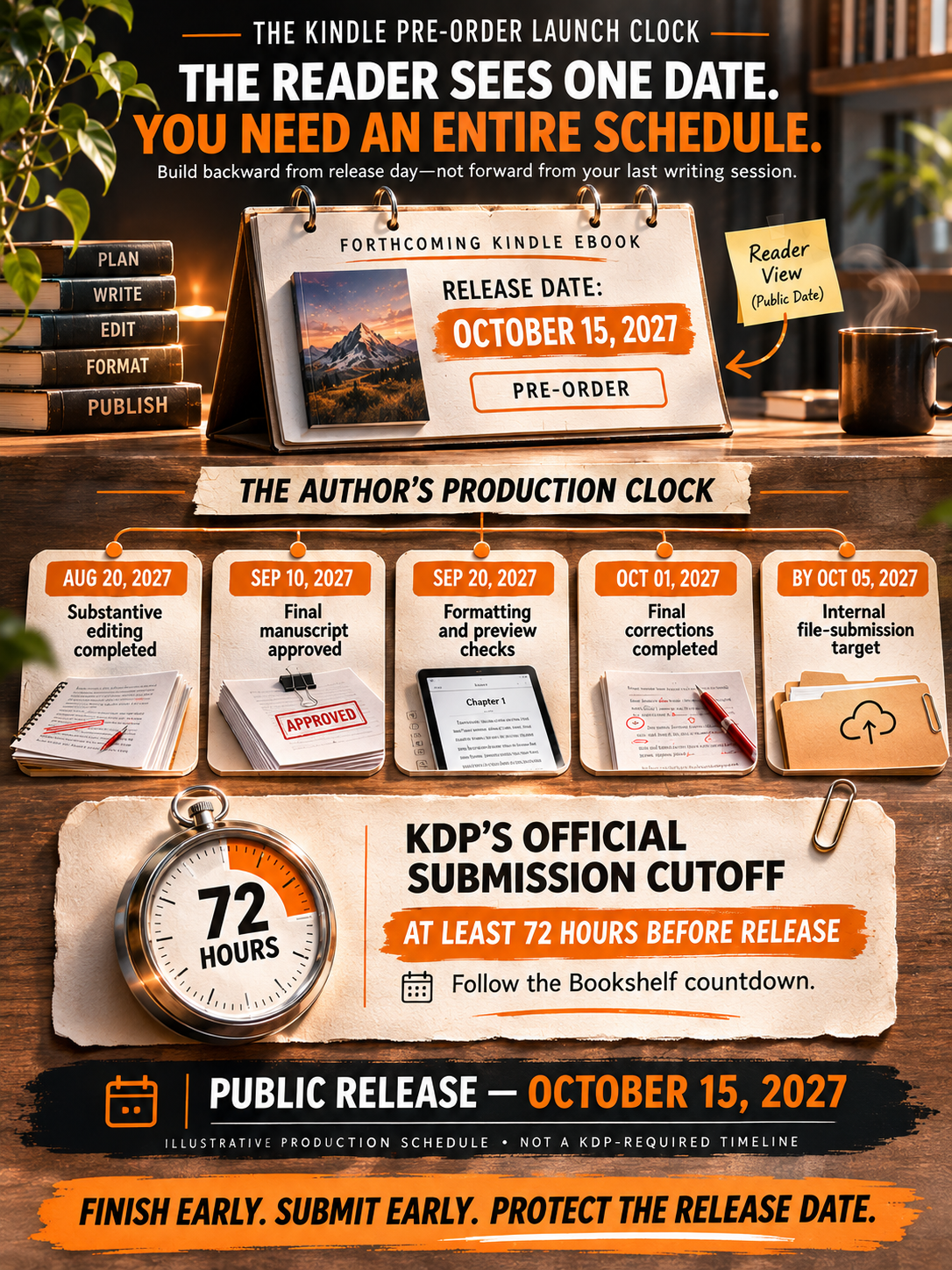
Suppose your ebook is scheduled to release on October 15, 2027.
The final submission deadline falls approximately three days earlier, according to KDP's displayed countdown and release-time settings.
That does not mean you should schedule your final proofreading for October 12.
A more sensible production plan might look like this:
| Internal Milestone | Illustrative Target |
|---|---|
| Complete substantive editing | August 20, 2027 |
| Approve the final manuscript | September 10, 2027 |
| Complete Kindle formatting and preview checks | September 20, 2027 |
| Complete final corrections | October 1, 2027 |
| Submit approved ebook files | By October 5, 2027 |
| Scheduled ebook release | October 15, 2027 |
Illustrative schedule, not an actual author project or a KDP-required production timeline.
This gives the author time to respond if a file fails review or requires another correction.
Your dates will depend on the manuscript and publishing workload.
For a broader explanation of manuscript preparation, editing, formatting, and platform review, see our guide to how long it takes to publish a book.
What Can You Change Before the Deadline?
KDP generally permits updates to your ebook's manuscript, cover, description, categories, keywords, and other supported details before the submission deadline, subject to review-status restrictions.
After submitting your final manuscript, changes may be temporarily unavailable while KDP reviews the book.
Once the pre-order enters the final ready-for-release period, last-minute updates are restricted.
The safest approach is to submit well before the deadline, then avoid unnecessary late changes.
Can You Postpone a Kindle Ebook Pre-Order Under the 2026 Rules?
Yes, but the permitted postponement depends on when you created the pre-order.
For a new pre-order created on or after September 2, 2026, you can postpone the release up to twice.
The new date must remain within six months of the originally selected release date.
For older pre-orders, KDP generally allows one postponement, up to 30 days beyond the existing release date.
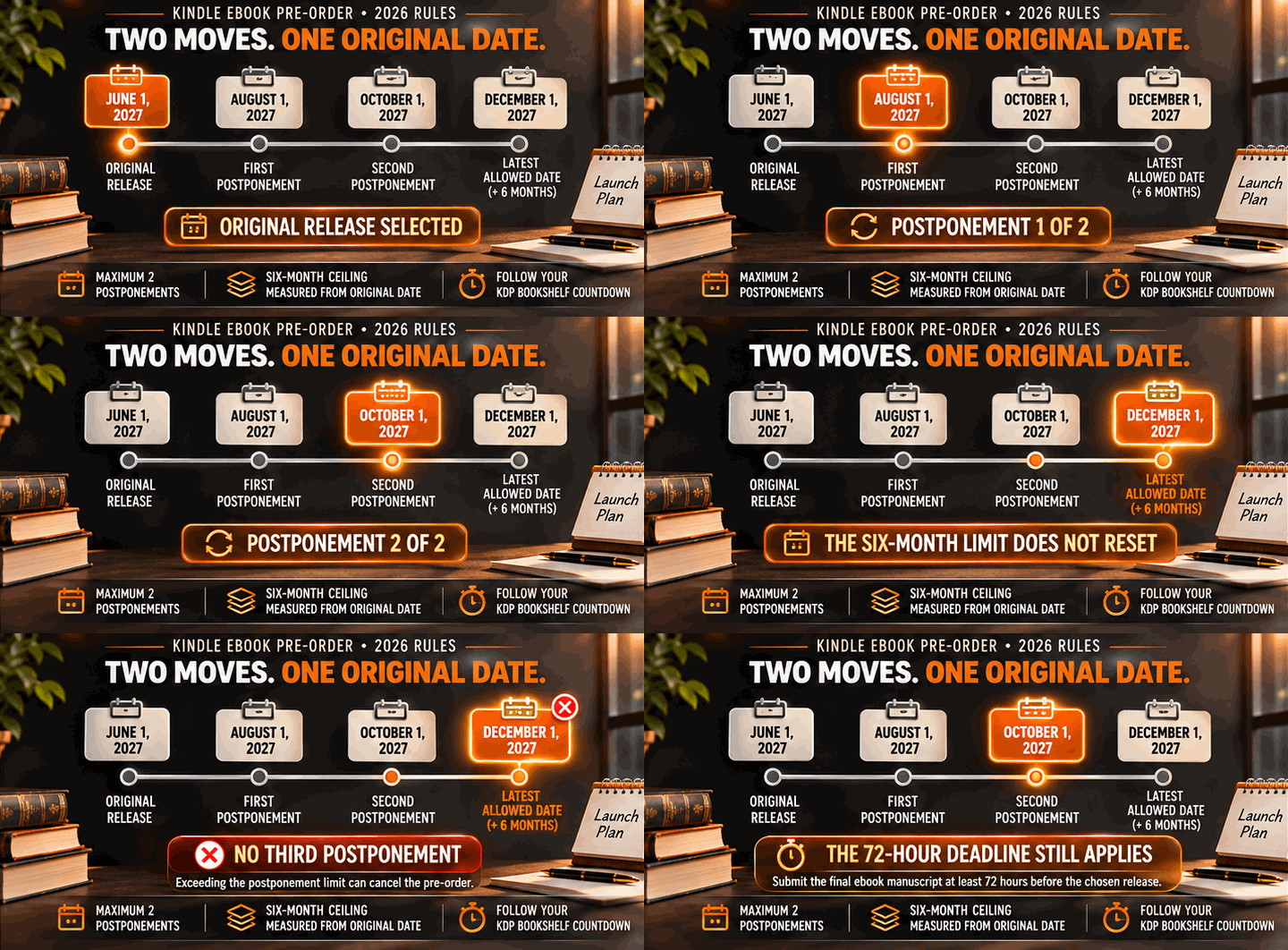
Example: Two Postponements, One Original Deadline
Imagine you create a new pre-order with an original release date of June 1, 2027.
Your editor later identifies additional revisions.
You postpone the release to August 1.
A second revision cycle then requires another delay, so you move it to October 1.
Under the newer rules, those two postponements can fit the permitted limits.
But the six-month extension is measured from the original June 1 date, not restarted every time you change the schedule.
You cannot keep extending the book by six months after each postponement.
How to Change Your Release Date
For a live pre-order, the process described by KDP is:
- Open the title in your Bookshelf.
- Select the three-dot action menu.
- Choose Edit eBook Pricing.
- Select the new release date.
- Submit the changes using Publish.
Make the adjustment before the 72-hour submission deadline.
Customers who pre-ordered the ebook are notified of the revised date.
The full limits and consequences are explained in Amazon's official pre-order postponement and cancellation rules.
What if You Want to Release the Ebook Earlier?
If your manuscript is completed ahead of schedule, you may be able to move the release date forward.
For a live pre-order, KDP requires the final manuscript to be submitted and reviewed before an earlier release date can be selected.
KDP's current instructions place the earliest new release date at three days from the time of the change.
Don't promise readers an immediate early release before confirming the option available for your title's current status.
What Happens if You Cancel Your KDP Pre-Order?
The 2026 rules are less severe for a first mistake than older guidance suggested.
However, cancellation still has real consequences.
| Account History | Current Consequence |
|---|---|
| First cancellation or missed manuscript deadline | One-time account-level courtesy; pre-order privileges remain |
| Second cancellation or missed manuscript deadline | Pre-order privileges removed for six months across the catalog |
| Privileges removed before September 2, 2026 | Previously imposed one-year penalty remains applicable |
While privileges are suspended, you cannot create new pre-orders or postpone existing ones.
You can still publish books without the pre-order feature.
Canceling a live pre-order also cancels customers' outstanding reservations and prevents you from reusing the same ASIN for a replacement pre-order.
A replacement requires a new book setup.
Why This Matters for Authors Publishing a Series
Suppose you're preparing three connected ebooks.
You create pre-orders for all of them based on an aggressive writing schedule.
If the first title is canceled and a later title misses its deadline, your account can lose pre-order privileges across the catalog.
That affects more than the individual book that caused the problem.
Pro Tip: Don't make the publication schedule dependent on every stage going perfectly. Build realistic approval and revision time into the plan before offering readers a fixed release date.
When Does an 18-Month Ebook Pre-Order Actually Make Sense?
The new maximum window is an option, not a recommendation to use all 18 months.
The best duration depends on your readers, your production certainty, and what you intend to do during the pre-launch period.
Authors Who May Benefit From a Longer Window
Established series authors: Readers may already be waiting for the next installment. An advance listing provides a destination for announcements and future promotions.
Authors with a planned nonfiction launch: A business or educational book may be coordinated with speaking engagements, courses, or professional events.
Creators with an engaged audience: A newsletter, podcast, or existing reader community can provide a practical way to introduce the upcoming book over time.
Authors with a reliable production schedule: A longer window may support planning when the content is well defined and the remaining writing work is realistically mapped.
When a Shorter Pre-Order May Be Better
A shorter window may make more sense if:
- The manuscript still lacks a clear structure.
- You have not chosen the book's final audience or positioning.
- Editing requirements remain uncertain.
- The release date depends on contributors or approvals outside your control.
- You have no realistic plan for promoting the book before launch.
A public pre-order date is a commitment to readers.
Don't create that commitment solely because KDP now allows a longer interval.
The Release-Date Confidence Test
Before opening the pre-order, evaluate three things.
| Question | What a Credible Answer Looks Like |
|---|---|
| Is the book defined? | The audience, promise, structure, and publication format are clear |
| Is the deadline achievable? | Remaining writing, editing, formatting, and approvals fit the schedule with a reasonable buffer |
| Is there a pre-launch purpose? | You have relevant reader communication or launch activities planned, not just a distant date |
If all three are clear, opening a pre-order may be sensible.
If the first two are unresolved, consider delaying the listing until you understand the remaining production work.
If the book is ready but promotional plans are weak, you may not need a longer pre-order. You may need a more focused launch strategy.
How Should Authors Use the Extra Pre-Order Time to Market a Book?
An Amazon pre-order page gives readers somewhere to reserve your ebook.
It doesn't create a waiting audience by itself.

KDP states that pre-orders can contribute to sales rank and Kindle Store merchandising before release.
But that does not mean selecting an 18-month window guarantees visibility, pre-order sales, or a strong launch-day rank.
The marketing value depends on reaching people who are likely to care about the book.
Phase 1: Establish the Book's Position
Identify the intended reader, genre expectations, central promise, and reasons someone would choose the book.
Review the cover and description as a new customer would.
The listing should explain what the book is before you begin directing traffic toward it.
Phase 2: Build Relevant Interest
Use the channels where your readers already engage with you.
That might include an author newsletter, social media community, podcast, speaking engagements, or existing book audience.
Rather than repeating the same pre-order announcement for months, share material connected to the book's purpose.
For a practical nonfiction title, this might involve relevant research, a short lesson, or an explanation of a problem the book addresses.
Phase 3: Give Readers a Clear Release Schedule
Communicate meaningful updates as the manuscript progresses.
Readers may appreciate knowing when the cover is revealed, the description is finalized, or the release date is approaching.
Avoid making promises about material you haven't finished.
Phase 4: Prepare the Release and Follow-Up
As the final manuscript nears approval, review your book page, release communications, author information, and marketing assets.
Plan what happens after publication, too.
A pre-order campaign is only one stage of a book's commercial life.
If you need a structured plan around audience positioning, launch communication, or approved promotional spending, book marketing services may support that work.
How Are KDP Pre-Order Sales, Prices, and Royalties Reported?
Pre-order activity can be misunderstood because advance reservations and completed sales aren't the same reporting event.
KDP provides a dedicated Pre-Orders Report that shows reserved units, cancellations, and net pre-order units.
Those figures help you monitor advance interest.
However, pre-order sales generally appear in other sales and royalty reporting after the ebook is delivered to customers at release.
Depending on the marketplace and time zone, activity may be processed near the end of the preceding calendar day.
Can You Change Your Ebook Price Before Release?
Yes, within KDP's applicable pricing rules.
For most relevant marketplaces, when you lower the pre-order list price, customers who reserved the book earlier benefit from the lower price.
If you raise the price, earlier customers generally retain the lower price at which they reserved it.
Some marketplaces, including Germany, have additional requirements or exceptions.
Don't plan a series of price changes without considering their effect on existing reservations and expected royalties.
Does KDP Select Work With Pre-Orders?
Yes. You can enroll an eligible pre-order ebook in KDP Select.
The enrollment term begins on the ebook's release date, not when its pre-order listing first becomes available.
KDP's Free Book Promotions and Kindle Countdown Deals cannot be scheduled as pre-release promotions; they become available under the applicable rules after publication.
That distinction matters when preparing a launch calendar.
Common Mistakes Authors Make With the New 18-Month Window
Mistake 1: Assuming More Time Means Less Deadline Risk
An 18-month window gives you more planning time.
It doesn't change the requirement to deliver the approved manuscript before KDP's submission deadline.
Do this: Set an internal manuscript deadline comfortably earlier than the official cutoff.
Not that: Plan to finish writing during the final 72 hours.
Mistake 2: Creating a Pre-Order Before the Book Has a Direction
A public listing is harder to market when the title, audience, and central promise keep changing.
Complete enough editorial planning to describe the book accurately before opening reservations.
Mistake 3: Confusing a Print Scheduled Release With an Ebook Pre-Order
KDP's paperback and hardcover scheduling features do not offer the same advance customer-ordering process.
Plan each format separately.
Mistake 4: Treating Postponements as Unlimited Extensions
The newer policy permits two postponements within a defined window.
The six-month limit does not restart after the first change.
Mistake 5: Watching Rankings Without Checking Actual Orders
Pre-orders may influence Kindle ranking activity, but rank movements alone don't show how many reservations you have received.
Use the available reporting tools to monitor actual order activity and cancellations.
Mistake 6: Following Publishing Guides Written Before September 2026
Older information may still describe a 12-month limit, one postponement, or the previous penalty period.
Check the creation date of your pre-order and KDP's current rules before making changes.
For other avoidable publication problems, read our guide to self-publishing mistakes on Amazon.